
The history knowledge guest blog series is celebrating Route 66’s 100th birthday in 2026! This legendary road, which ran diagonally through Illinois on its way to Santa Monica, California, is part of The Mother Road and Iconic DuPage Firsts exhibit at the DuPage County Historical Museum. You can check it out from August 15th to November 14th, 2026.
The Beginning
Illinois’s 300 miles of the “Mother Road” has a fascinating history filled with twists and turns. The famous highway has its roots in the early paths carved by Native Americans. The first residents of the state traveled along a dirt path that stretched from Chicago to St. Louis, which European settlers later named the “Pontiac Trail,” after the famous Odawa war chief who died near Cahokia, Illinois.
As more European settlers moved to Illinois, horse traffic grew, but the prairie wasn’t ideal for busy roads. By the early 1900s, the pathways were in poor shape, and the rich soil quickly turned into a muddy mess in the spring, making it hard for horse-drawn goods to reach the market. In the summer, these muddy roads often turned into thick dust. When the automobile culture began to take shape in America, the government began investing in road improvements. Paved roads were in demand and lawmakers were eager to deliver. In both 1916 and 1921, federal highway laws laid the groundwork for the National Highway System, which played a big role in shaping Route 66.
In 1924, Illinois cleverly repurposed the old Pontiac Trail’s roadbeds to build Illinois 4, linking Chicago to St. Louis. By 1926, Route 66 took over much of Illinois 4, thus Illinois was the first of the eight Route 66 states to be completely paved. The highway gave a boost to the local economies, and soon, towns were buzzing with travelers eager to visit the diners, gas stations, and fun roadside spots which sprang up, some of which are still around today!
Route 66 wasn’t just a symbol of freedom and adventure; it also played a significant role in the rise in alcohol consumption! Prohibition began in 1920 and the smooth, all-weather road made it easy to move illegal booze. Moonshine stills popped up all over the Midwest to meet this demand and Route 66 made it a smooth shot to speakeasies from Chicago to St. Louis.
Growth and Change
Route 66 has seen a few changes over the years. The starting point for Route 66 had three different locations over the years. In 1926, the road began at the corner of Jackson Boulevard and Michigan Avenue. From 1938 through 1954, the starting point was rerouted along Lake Shore Drive, so the new beginning of the Mother Road moved two blocks east. When Jackson became a one-way street in 1955, the starting point became East Adams Street and Michigan.
Originally, when heading south out of DuPage County, the highway traveled through Joliet on its way to Wilmington. As traffic grew, Joliet was bypassed and the highway diverted through Plainfield meeting back up with the original road in Gardner. The original path into Joliet was then renamed Alternate 66.
Post-war prosperity through the 1950s was the golden age of Route 66. Overall economic prosperity was strong as rising wages and pro-business regulations led to a new spirit of consumerism. Suburban growth made automobiles a necessity rather than a luxury and car ownership soared by over 40% from 1940 to 1960. Vacation road trips used “the Main Street of America” as the primary route for the family holiday.
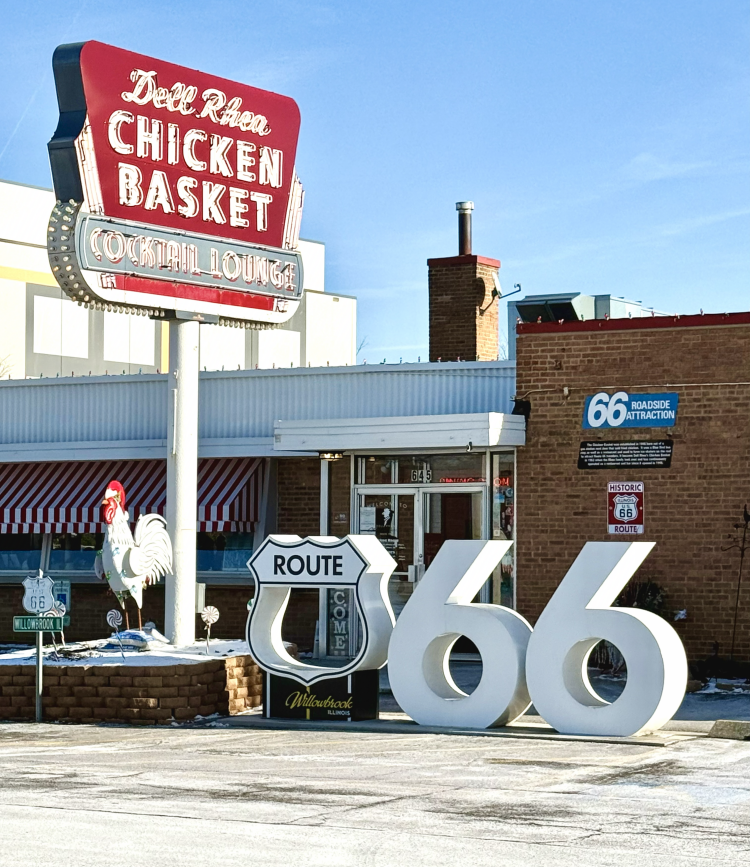
Quirky roadside attractions like the Gemini Giant in Wilmington and the world’s largest water tower, the Brooks Catsup Bottle in Collinsville, made the highlight reel for these travelers. Local eateries such as Dell Rhea’s Chicken Basket in Willowbrook and Ariston Café in Litchfield developed a loyal following. Local filling stations such as Ambler Texico in Dwight or Mt. Olive’s Soulsby Service Station helped travelers with their gas and oil needs as they traversed the country on Route 66.
The Fall of the Mother Road
Even before the old highway came to an end, changes were underway. Growing auto and truck travel made traffic congestion and bottlenecks occur on the original two-lane road. Whenever possible, the old route was widened to four lanes. Plus, business loops were created, so tourists and commuters could zip around the small towns without having to slow down. Unfortunately, this meant that local mom-and-pop shops didn’t get the business they once had and these unique forms of Americana slowly faded away.
The final nail in the coffin came from President Eisenhower, who favored a large national highway system of interstates, built to uniform construction standards. The Federal Highway Act of 1956 was the answer and an organized network of high speed, multi-lane freeways with no traffic lights and limited exits were designed and built over the next two decades. Today, the country’s interstate system of paved interstates now totals almost 50,000 miles of asphalt.
Here in the Prairie State, Interstate 55 began construction to replace Route 66 and was completed in 1979. The Route 66 signage had already been removed by that time and the “Main Street of America” from Chicago to the Santa Monica Pier was officially decommissioned in 1985.
The Rebirth
Today, we have seen a strong resurgence and reverence for the “The Main Street of America.” The thirst to relive a unique piece of Americana - to slow down and enjoy the small-town charms, the glitchy roadside attractions, the quaint local diners. During this centennial celebration year, you can still get your kicks on Route 66!